

New RISE report surveys Swedish and Norwegian leisure boat owners' views on electric power
Interest in electric leisure boats is growing, but there are still practical and economic issues that need to be addressed on the road to fossil-free boating. This is shown in a new report from RISE Research Institutes of Sweden within the Interreg-funded project go:LEIF, which aims to accelerate the electrification of recreational boats in the Skagerrak region.
The survey, conducted in 2023-2024 in collaboration with Innovatum and the Norwegian University of Southeast Norway (USN), gathered 270 responses from Sweden and Norway. The results provide a snapshot of how boat owners view the opportunities and challenges of electric power.
Day trips dominate - short distances common
The majority of respondents own open motorboats (30%), larger overnight motorboats (27%) or sailing boats (27%).
The most common use is for day trips, reported by half of the respondents. Longer continuous trips account for 29%, while fishing, water sports and racing account for smaller shares.
For the most common trip, 80% state that they travel less than 16 nautical miles. The distances traveled are generally short and of the 81 responses that indicated specific distance in nautical miles, two thirds indicated that they travel less than 300 nautical miles per season. The survey also provided an indicator of the amount of fuel used in a season, the most common response being 20-40 liters by 91 respondents.
Environment and quieter operation attract
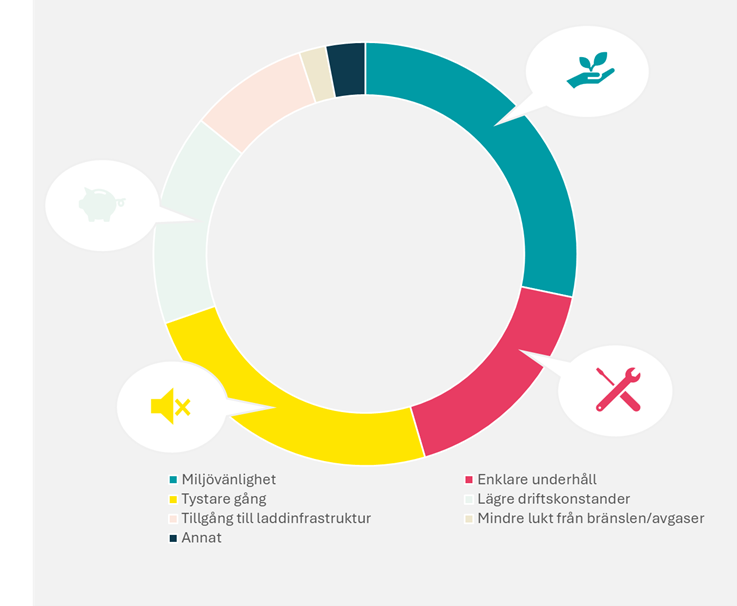
Boat owners' strongest drivers for switching to electricity are environmental concerns and comfort.
As many as 28% say that the environmental friendliness of electric power is the main reason for buying or converting to an electric motor. Almost as many (25%) cite quieter running, while easier maintenance (17%) and lower running costs (16%) also play a major role.
Recreational boaters who have already switched to electricity also highlight the calmer experience on the water and the better control in ports and shallow waters.
- "The responses from boat owners particularly emphasize that it is a more environmentally friendly boat trip in several aspects such as comfortable boat ride with quieter operation and no smell of exhaust or fuel. They can enjoy the entire boat trip", says project manager Cecilia Strokirk, RISE Maritime.
Insights from the survey responses can be used to help improve the marketing of electrically powered recreational craft.
High costs and lack of charging slow down interest
Despite curiosity, few have taken the plunge. Only one percent of respondents own an electric boat.
The most common barriers are high purchase costs (30%), lack of charging stations (25%) and concerns about limited range (19%).
Many boat owners also express uncertainty about the environmental impact and safety of batteries, especially fire risk. Others point out that they recently bought a new boat with an internal combustion engine and therefore do not plan to switch.
Potential - but requires infrastructure and knowledge
RISE emphasizes that the results are not statistically representative, but that they provide important indications. Most boat trips are short, which means that the range anxiety is often greater than the actual need.
- "Many people use their boats for day trips within a few miles. This shows that electric power could already cover a large part of leisure boating today, if the right charging facilities were in place," says report author Sara Rogerson, RISE Maritime.

When asked "How do you use the boat today?" half of the answers were for day trips. Out of 333 responses, where respondents had the possibility to give multiple answers, just under a third (29%) highlighted the use of the boat today for longer continuous trips. 12% indicated that they used the boat for fishing trips, 4% for water sports and 2% for racing. As one of the respondents pointed out in the free response, usage can vary and therefore the chart should not be read as 50% of the boat owners only do day trips: "8-9 weeks summer vacation with the boat. Weekend trips spring, early summer, late summer and fall. Occasional weekend trips in winter and over Christmas and New Year". Several more answers in the other category concerned accommodation or commuting to islands.
Quick facts
- Objective: Promote electrification of recreational craft in the Skagerrak region
- Funding: Interreg Sweden-Norway
- Participants: RISE, Innovatum Science Park, University of South East Norway (USN)
- Number of responses: 270 (218 Swedish, 52 Norwegian)
- Most common boat: Open motorboat (30%)
- Most common reasons for using electricity: Environmental friendliness
- Most common barrier: Purchase cost
The survey results are part of the results collected within the go:LEIF project and should be considered together with additional data to provide input regarding charging needs for potentially larger future shares of recreational boats with electric engines. The survey results should be considered together with other sub-results within the go:LEIF project, such as an analysis of AISB data for recreational boats along the west coast, interviews and statistics with boat owners, ports and the business community.


